
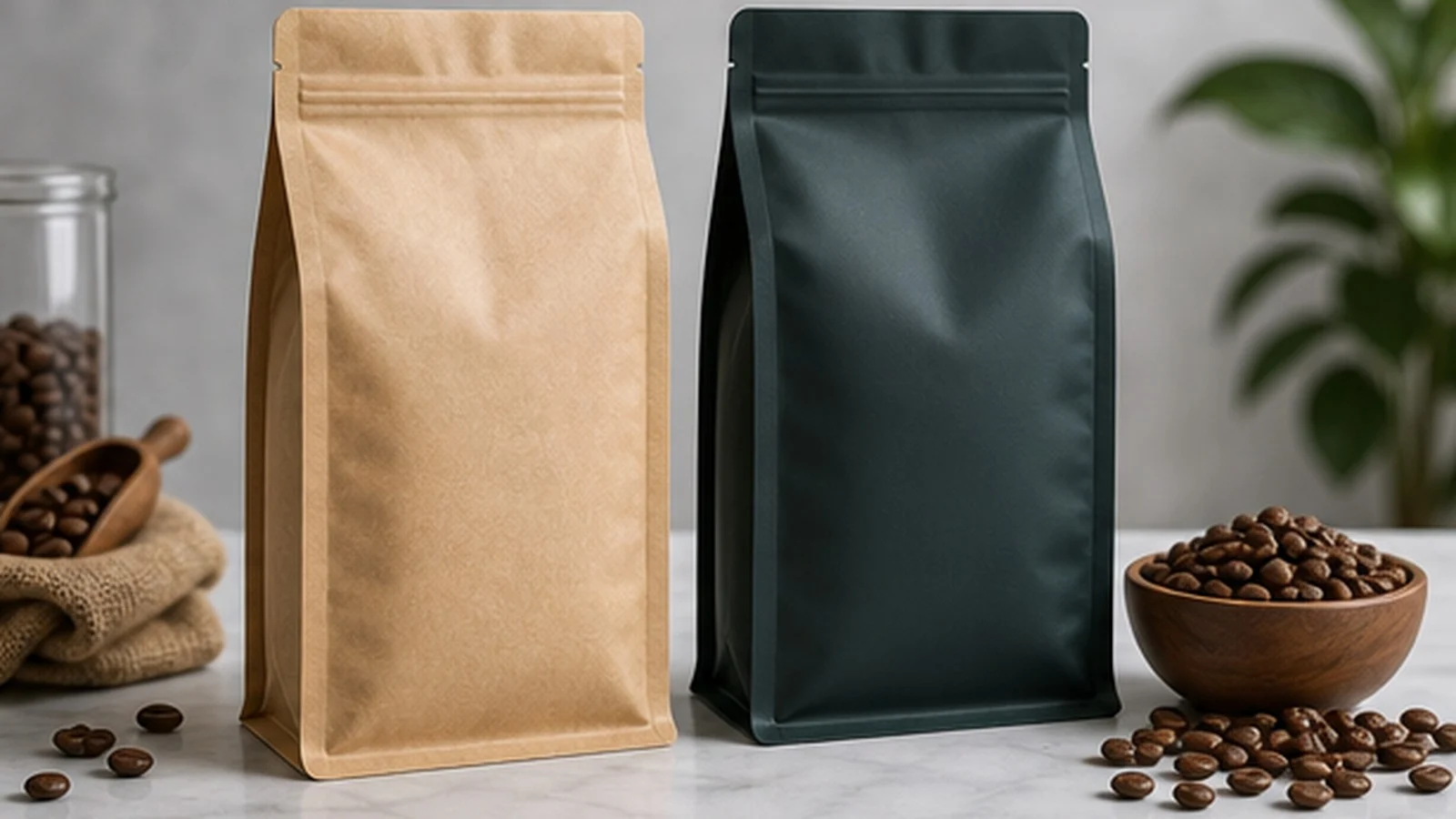
Specialty coffee brands usually narrow their packaging down to two surfaces: natural kraft paper or matte laminated film. Both look premium in different ways, and the practical differences run deeper than finish.
Kraft paper
Kraft gives an unmistakable artisanal texture and reads as natural on shelf. Because paper is porous, it always sits on top of a barrier laminate such as kraft / AL / PE, so the barrier comes from the layers underneath rather than the paper itself. Print reproduction is softer: fine gradients and bright colours are muted by the brown base, and white cannot be printed as brightly without an underlayer.
Matte film
Matte BOPP or PET-faced structures hold fine detail, support accurate brand colours and take spot gloss or soft-touch effects cleanly. They also resist scuffing better in transit. What they do not deliver is the tactile paper texture some brands rely on for positioning.
Comparison at a glance
- Colour accuracy: matte film is stronger, especially for pale or vivid brand colours.
- Perceived craft: kraft is stronger in artisanal and single-origin positioning.
- Barrier: equivalent, since both rely on the laminated layers beneath.
- Cost: kraft usually carries a modest premium.
- Recycle-ready options: currently broader in film-based mono-material structures.
Deciding with samples
Colour behaves differently on the two surfaces, so we recommend a printed proof on both before committing. We supply proofs on the actual structures with your artwork so you can compare them under retail lighting rather than on screen.