
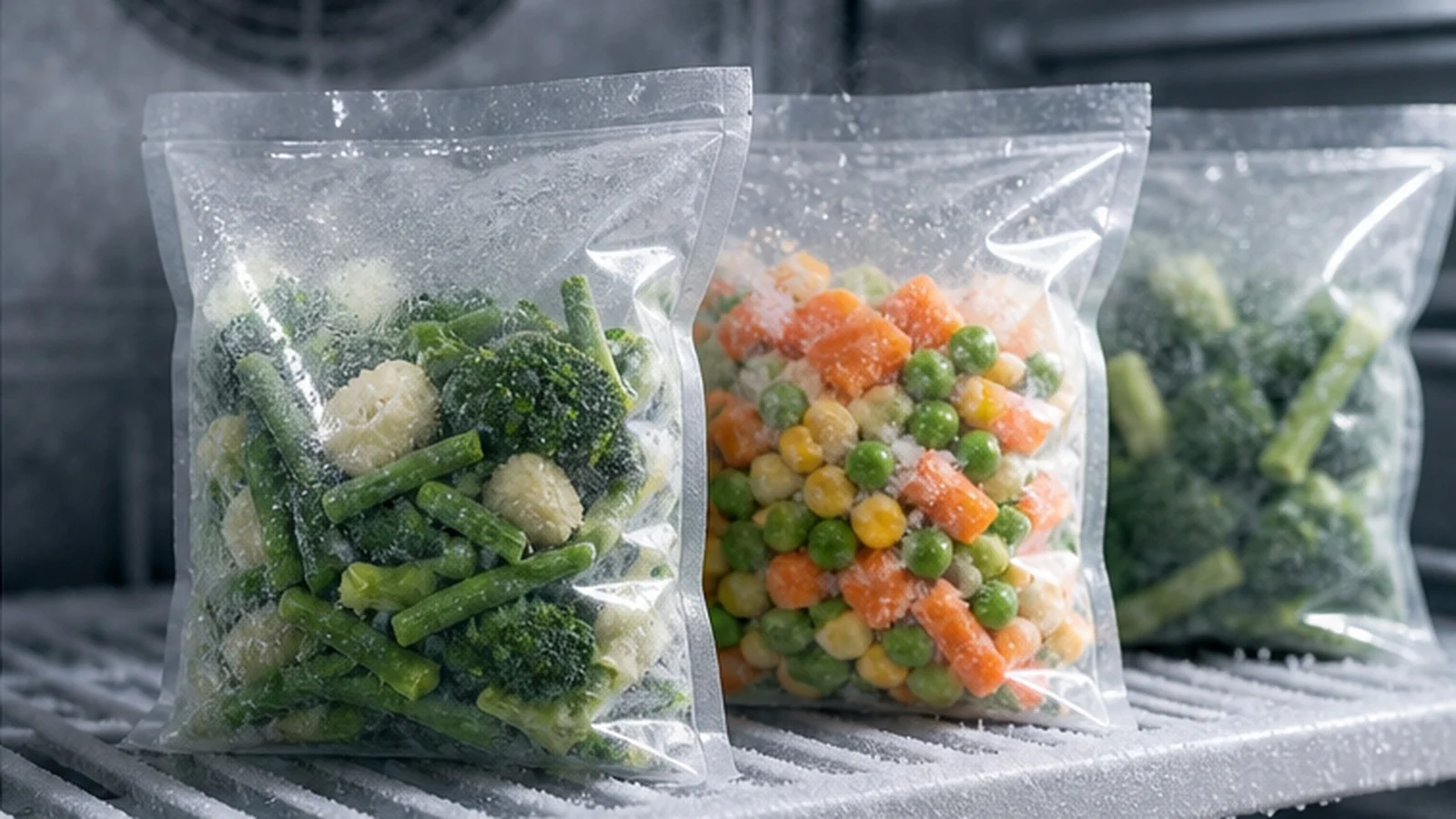
At minus 18°C most polymers become stiffer and more brittle. Packaging that passed a drop test on a warm loading dock can split at the seal or along a fold after a week in a freezer, which is why frozen applications call for structures chosen specifically for low-temperature behaviour.
Films that stay flexible
Polyethylene-based structures retain flexibility well below freezing, which makes PE / PE and PA / PE the usual starting points. Nylon adds toughness and puncture resistance, useful for products with bones, edges or ice crystals. PET / PE offers stiffness for stand-up formats but needs care in seal design at very low temperatures.
Frost, condensation and seals
Moisture on the film surface during filling can weaken seals, and repeated freeze-thaw in an imperfect cold chain drives condensation inside the pack. Seal design has to allow for a slightly contaminated seal area, so wider seals and lower-temperature sealants are typically preferred over narrow high-temperature seals.
Design checklist
- Confirm the film is rated for your lowest expected transport temperature, not just storage.
- Specify wider seals for products handled while frozen.
- Consider tear notches that still work with gloved hands.
- Check ink and lamination adhesion after freeze-thaw cycling, not only when new.
Testing that matches the cold chain
We run drop tests on frozen filled bags and freeze-thaw cycling on printed samples so you can see how both the structure and the artwork hold up. Testing at ambient temperature alone will not predict cold-chain failures.