
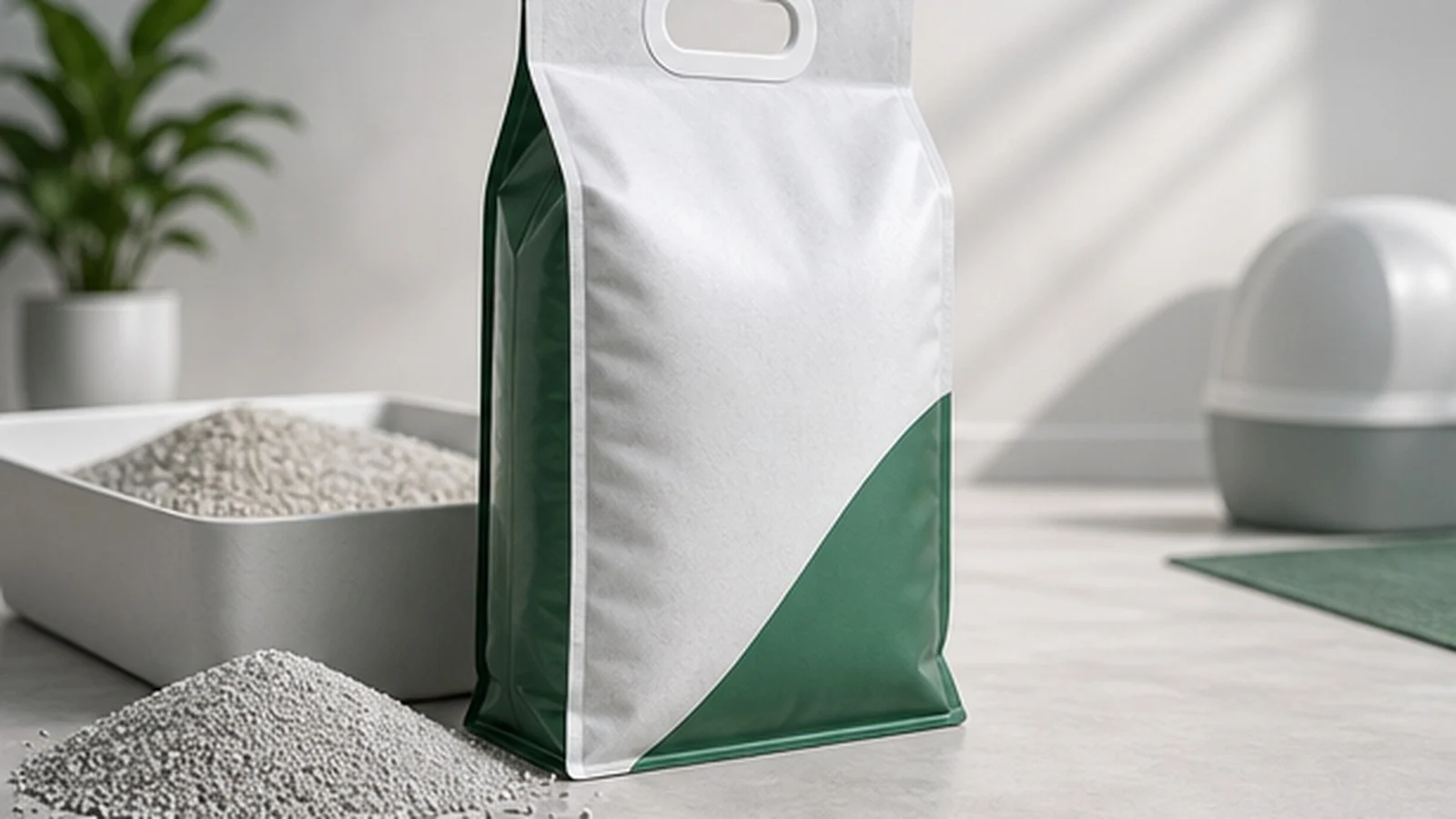
Cat litter combines three demands that rarely appear together: high unit weight, abrasive contents and repeated consumer handling. A bag that works for pet food will not necessarily survive a litter fill.
Structure and strength
BOPP / PE covers most bentonite and tofu litter at moderate weights. For 7.5 kg and above, or where pallets are handled roughly, BOPP / PA / PE adds the puncture and tear resistance needed to prevent corner failures. Bentonite in particular abrades the inner layer, so sealant thickness has to be specified with the fill in mind.
Seal and handle design
- Wide bottom seals distribute load better than narrow ones and reduce corner splits during drop.
- Die-cut and reinforced handles must be positioned so the load hangs in line with the seal, not across it.
- Three-side and four-side seal formats both work; four-side seal gives a squarer stack for palletisation.
Dust and venting
Fine litter dust creates two problems: it interferes with sealing if it settles in the seal area during filling, and it escapes during consumer pouring. Micro-perforated venting can help air escape during filling without letting dust out, but the perforation pattern has to be matched to the particle size.
Validating before volume
We test filled bags with your actual litter through drop, vibration and stacking sequences that reflect real pallet transport. This is the step that catches marginal seals before a container arrives with split bags.